



Click Here to get your Fellow Ticket
Click Here to get your Non-Fellow Ticket
Meeting topics and rationale
The majority of stars are orbited by one or more small close-in planets. These planets, which are 1-4 Earth radii and have orbits interior to that of Mercury, do not have solar system counterparts. Thousands of such exoplanets are now known. One of the most startling observations is that these planets appear to come in two flavours, with an absence of planets around 1.8 Earth radii separating the smaller planets, known as super-Earths, from the larger planets, known as sub-Neptunes. The super-Earths and sub-Neptunes are separated by what has become known as the exoplanet radius valley, which in many ways has become the default framework by which to understand these types of planets. The focus of this meeting is to bring together experts on the formation and evolution of small exoplanets and to hold a specialist discussion on the exoplanet radius valley. We expect to discuss several of the leading theories such as photoevaporation, core-powered-mass
loss, and late gas-poor formation, and confront these with the latest observations of super-Earth and sub-Neptune exoplanets. We will also look towards the future, and in particular discuss the exciting prospects the upcoming PLATO mission will offer.
Organisers
Vincent Van Eylen (UCL)
James Owen (Imperial)
James Rogers (Cambridge)
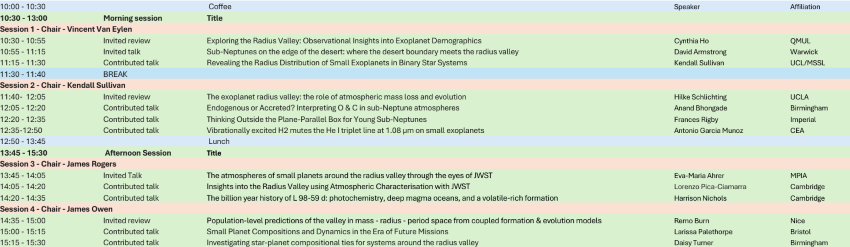
Confirmed invited speakers
Hilke Schlichting (UCLA)
Cynthia Ho (QMUL)
Sydney Vach (ESO)
Eva-Maria Ahrer (MPIA)