


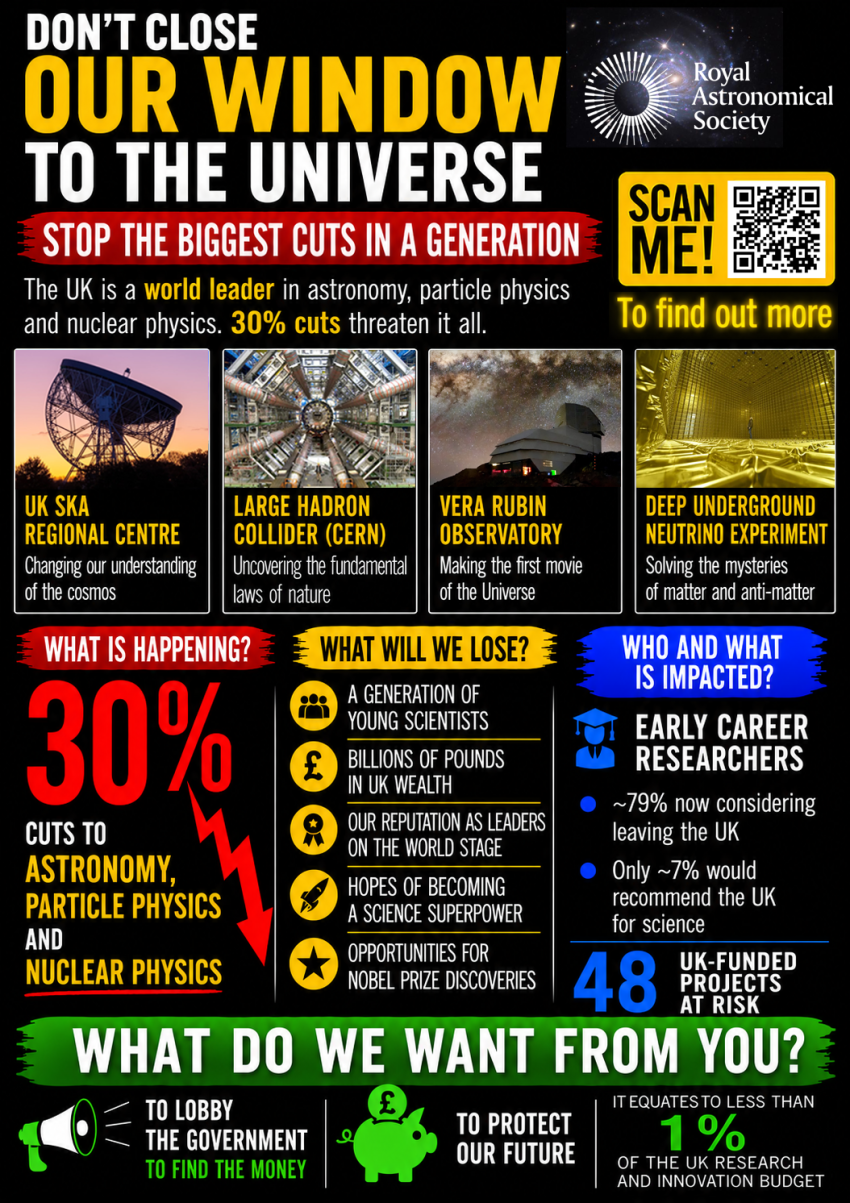

Budget breakdown
The UK government has made a record £39B investment in UK Research and Innovation (UKRI) across the spending review period, with ~9% of that budget invested in the Science and Technology Facilities council. STFC runs the UK’s national facilities, and supports particle physics, astronomy and nuclear physics (PPAN) research in the UK.
STFC has been given a ”flat cash” settlement across the SR, despite rising costs, such that “STFC must make significant cumulative savings” (Ian Chapman 1st Feb). The total amount of STFC savings required within the four-year Spending Review period is has not been made public, despite a number of FOI requests. We do, however, know that
- Total savings will rise to ~£162M per annum by 2029/2030 (~20% STFC budget)
- PPAN cuts will rise to ~£54M per annum by 2029/2030 (~30% PPAN budget)
Cuts fall disproportionately on the PPAN community, as the required savings cannot be made on rising electricity costs for UKRI’s facilities and the rising subscription costs which are governed by international treaties.
Lord Vallance has stated that “UKRI must find a way to look after so-called PPAN” but UKRI has yet to suggest an alternative to the catastrophic proposed 30% cuts.
Protecting curiosity-driven research
We agree with Lord Vallance when he says “My number one priority is to protect and grow curiosity-driven research… It matters enormously because … it is that work that ultimately creates wealth in 10 or 20 or 30 years’ time”.
Yet, according to Research Professional News all UK curiosity-driven research funding will be reduced in real-terms, to allow for a 13% rise for government priorities, and a 19% rise for commercialisation. Only 8.8% of UKRI funding is invested in what most would consider “curiosity-driven research” (Peiris - Nature Reviews in press)
The negative impact on early career researchers and the innovation talent pipeline
In 2024/2025 STFC cut funding for early career researchers by 15%. DSIT’s recent commitment to protect PPAN postdoc numbers has been welcomed, but it fixed the grant-panel-awarded postdocs at their lowest number since the 2008 financial crash. No equivalent protection exists for the large proportion of researchers employed through the STFC-funded project grants.
In a recent survey of PhD students and postdoctoral researchers we found that
- 80% are considering leaving the UK
- 89% have very low confidence in the pursuit of a future PPAN career in the UK
- Only 7% would recommend the UK for a PPAN career, compared to 74% before January
Not only do the cuts mean that we will lose the chance to carry out spectacular science (as discussed here), we’re also about to lose a generation of young scientists who are the crucial starting point for the UK’s innovation talent pipeline.
Transformative Technology
We have a strong track record of transforming astronomy and particle physics technology to improve everyday lives. For example, pioneering research to detect cataclysmic black hole mergers through gravitational waves has been used to improve retinal scanners and miniature gravity sensors used for water table monitoring, security and defense.
Radiation-hard sensors first developed for particle physics applications have revolutionised human biology through cryo-electron microscopy, allowing biomolecules to be frozen and “seen” mid-movement.
The UK’s international reputation is being damaged
All STFC-funded projects have been identified as “at risk” in the current prioritisation exercise. All represent UK leadership within large international collaborations that have been designed to lead to breakthrough discoveries. STFC concluded their prioritisation exercise to determine how and which of these projects will be cut in early June. They have not shared their conclusions with the research community, however, or consulted with the Institute of Physics or Royal Astronomical Society.
UK Leadership at CERN: uncovering the physical laws of nature
UK Leadership at the European Southern Observatory: cutting-edge technology to explore the cosmos
UK leadership to understand the fundamental building blocks of the Universe
- In major US facilities:
- In other major international facilities:
- HyperK and T2K (Japan)
- FAIR (Germany)
- e-MERLIN (UK)
- LOFAR (Netherlands)
The UK-led search for dark matter
The UK’s search for life elsewhere in the Universe
Essential human infrastructure that facilitates breakthrough UK research
- ALMA UK
- CASU
- JCMT UK
- LIGO Operations
- STFC Particle Physics Department
- UK Astronomy Technology Centre
- UK SKA
- UK National Quantum Technologies Programme
- WFAU
High-performance computing that powers UK discovery