



To mark the Europlanet Science Congress 2026 taking place in The Hague (6-11 September 2026), the Royal Astronomical Society is delighted to celebrate some of the papers published in its journals during the past year.
First off is the 'ASTEP confirmation of a pair of long-period Jupiter sized planets with extremely low densities transiting' TOI-791 by Georgina Dransfield and colleagues in Monthly Notices of the Royal Astronomical Society (MNRAS). In the abstract the authors write: “We confirm their planetary nature using ground-based photometry, including multiple full detections of the > 11 h transits of both TOI-791 b and c from Antarctica with ASTEP, making these the longest-duration transits ever observed in their entirety from the ground.” Read more at https://academic.oup.com/mnras/article/549/4/stag864/8715235
Also published this year in MNRAS is the paper by Abigial Bohl and colleagues, 'Probing the limits of habitability: a catalogue of rocky exoplanets in the habitable zone'. In the abstract, the authors record that they identify 45 rocky worlds in the empirical habitable zone and 24 in a narrower 3D-habitable zone. Read more at https://academic.oup.com/mnras/article/547/3/stag028/8526432
Maggie Thornton and colleagues focused on another group of interesting exoplanets in 'Detection of 27 candidate circumbinary planets through apsidal precession of eclipsing binaries observed by TESS', also in MNRAS. Recognising in the abstract that the inferred properties of their candidates remain degenerate, as the same dynamical signatures can arise from lower mass planets at less than 1 AU or from more massive companions on wider, few-AU orbits, this is nonetheless a significant contribution to circumbinary exoplanet science. Read more at https://academic.oup.com/mnras/article/548/3/stag515/8524019
In the context of Arrokath, a contact binary member of the Kuiper belt, Jackson Barnes, Stephen Schartz and Seth Jacobson investigate 'Direct contact binary planetesimal formation from gravitational collapse', published in MNRAS. In the abstract, the authors discuss the possible theories concerning Arrokath's formation and state: “Here, we show that contact binary planetesimals like Arrokath can form directly from the gravitational collapse of pebble clouds”. Find out more at https://academic.oup.com/mnras/article/546/4/stag002/8488819
Also within the Solar System, 'On the detection of normal modes using InSight and their use in constraining Mars’ seismic structure', by Agnes Hendrickx, Inge Loes ten Kate, Arwen Deuss, has featured in Geophysical Journal International (GJI). The authors evaluate the data collected by the InSight mission and present the case for future deployment of seismometers on Mars, the Moon and other planets. Read the paper at https://academic.oup.com/gji/article/244/3/ggaf505/8442249
J A Cartwright and colleagues have published 'Assessing Mercury's composition using GREF: the BepiColombo MIXS Ground REference Facility' in our newest journal, RAS Techniques and Instruments. As stated in the abstract, they report the design, development and characterisation of GREF, dedicated to support the ESA/JAXA BepiColombo Mercury Imaging X-ray Spectrometer (MIXS), arriving at Mercury in 2026. The abstract concludes: “The GREF is thus key to understanding Mercury's composition, for ground-truthing analyses obtained remotely on Mercury, and data gathered using this facility will underpin all future observations made in space by MIXS. Find out more at https://academic.oup.com/rasti/article/doi/10.1093/rasti/rzag057/8758970
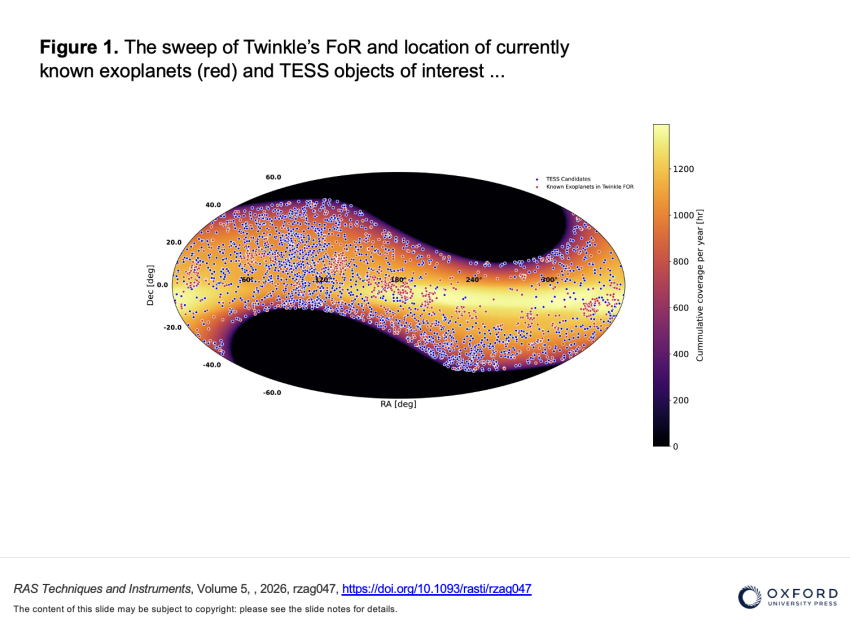
Finally in this small collection, we highlight 'Atmospheric characterization with the Twinkle Space Telescope following advances from JWST observations', by Tailong Zhang and colleagues. As stated in the abstract, Twinkle is a satellite designed for spectroscopic observations of a wide range of extrasolar and Solar System objects. In this paper published in RAS Techniques and Instruments, "we present here updated simulations evaluating Twinkle’s observational capabilities in the context of exoplanet atmospheres", taking HD 209458 b, WASP-107 b, GJ 3470b and 55 Cnc e as case studies. The researchers conclude: "Our sensitivity study highlights Twinkle's capability to detect less abundant/detectable molecules depending on the observing strategies adopted." Read more at https://academic.oup.com/rasti/article/doi/10.1093/rasti/rzag047/8729365