

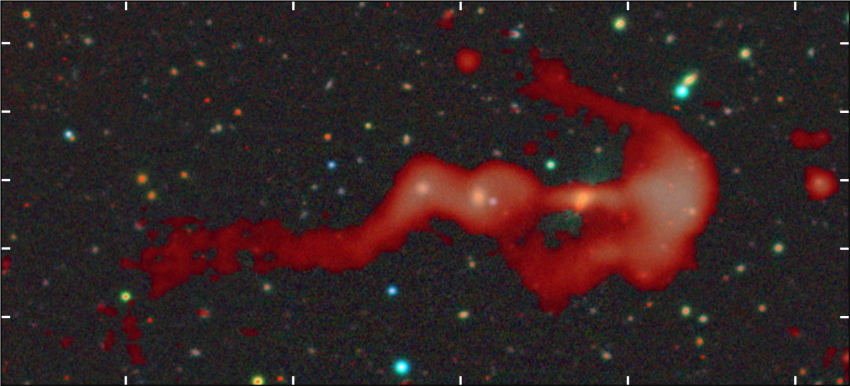

Astronomers have discovered a “remarkable” bow-and-arrow-shaped radio galaxy with an enormous arc-like structure extending nearly 1.8 million light-years across.
The newly-identified system, detailed in a new paper published today in Monthly Notices of the Royal Astronomical Society: Letters has a “highly unusual” and asymmetric structure which is unlike those seen in standard radio galaxies.
It was detected by an international team of researchers working with RAD@home Astronomy Collaboratory for citizen science research in India using ultra-sensitive images from the Low-Frequency Array (LOFAR) radio telescope.
They say it may represent one of the clearest known radio signatures of a giant bow shock generated by a galaxy falling supersonically into a cluster environment.
“The structure of this source is unlike that of any radio galaxy I have seen in the last 25 years,” said lead author Dr Ananda Hota, Founder, Director and Principal Investigator of RAD@home Astronomy Collaboratory.
“It’s remarkable morphology appears to display signatures of interaction between relativistic radio plasma and a large-scale shock generated during the galaxy’s infall into a nearby cluster environment.”
The discovery of the source – named RAD-BAARG (Bow-And-Arrow Radio Galaxy) – was made using data from the LOFAR Two-metre Sky Survey (LoTSS), one of the deepest radio surveys ever conducted at low frequencies.
Radio galaxies are powered by supermassive black holes located at the centres of galaxies which launch enormous jets of relativistic magnetised plasma into intergalactic space.
In RAD-BAARG, the researchers say one of the jets appears to interact with a large bow shock-like structure formed as the host galaxy falls through the surrounding hot gas toward a nearby cluster of galaxies.
Similar to the shockwave formed ahead of a supersonic aircraft, a galaxy moving faster than the speed of sound in the surrounding intracluster medium can compress the ambient gas and generate a large-scale shock front.
The radio-emitting plasma from RAD-BAARG appears to illuminate this otherwise extremely faint structure, making it visible in low-frequency radio images, according to the team. The western side of the source contains a narrow jet feeding a sector-shaped emission region and a giant arc-like feature extending over nearly 560 kiloparsecs (1.8 million light years).
On the opposite side, the jet develops a distorted S-shaped morphology followed by a faint offset tail extending to almost 600 kiloparsecs. The overall structure suggests strong interaction between the radio plasma and the surrounding large-scale environment.
The research team found that the host galaxy resides within a dynamically complex environment containing nearby cluster-scale systems at similar distances.
The observed morphology is consistent with interaction between the radio jets and large-scale environmental gradients, bulk gas motions, and possible shock-related compression associated with the galaxy’s infall.
Although theoretical studies and computer simulations have long predicted bow shocks around infalling galaxies, detecting them directly has proven extremely difficult because the surrounding gas is extraordinarily diffuse and faint.
A few candidate systems have previously been hinted at in X-ray observations, but RAD-BAARG provides an unusually detailed radio view of such a phenomenon.
Co-lead author Dr Pratik Dabhade, from the National Centre for Nuclear Research in Poland, said: “BAARG is exciting not just because of its striking bow-and-arrow shape, but because it sits in a complex multi-halo environment where gas flows, infall, and possible shocks can reshape radio plasma.
“LOFAR allows us to see this faint, low-surface-brightness emission in remarkable detail. With LoTSS DR3 and the future Square Kilometre Array Observatory (SKAO), we may find many more systems where radio galaxies reveal otherwise invisible interactions between jets, galaxies, and their environments.”
Another lead author Dr Shubhrangshu Ghosh, of SRM University Sikkim in India, said: “The reported observation reveals the first direct imaging of characteristic arc-shape morphology in radio frequency in regard to supersonically infalling radio-galaxy (most likely) onto a cluster medium - a spectacular textbook example of large bow-shock.
“Discovery of more such sources and their study during the SKAO era will provide much deeper insight about jet-ambient medium interaction and consequent feedback processes.”
The unusual source was initially noticed by RAD@home citizen scientist Pranim Limbo while inspecting LOFAR survey images.
Coming from a remote Himalayan hill region and without access to a major astronomy institute, the discovery highlights the power of collaboratory-style citizen science research in enabling university students and motivated learners to take part in frontline astronomical research.
Since 2013, RAD@home has trained participants across India to analyse astronomical data from world-class telescopes and contribute to professional scientific discoveries irrespective of their geographic or institutional backgrounds.
The discovery also points toward exciting future possibilities for next-generation radio astronomy facilities such as the SKAO, which is currently under construction and expected to become the world’s most powerful radio telescope.
Future ultra-sensitive surveys may uncover many more examples of shock-related interactions around infalling galaxies and help astronomers better understand how radio galaxies evolve within the large-scale cosmic environment.
The team are also hoping that artificial intelligence and machine-learning techniques could be used to identify additional unusual radio galaxies hidden within the enormous data volumes expected from upcoming radio sky surveys.
ENDS
Media contacts
Sam Tonkin
Royal Astronomical Society
Mob: +44 (0)7802 877 700
Science contacts
Dr Ananda Hota
University of Mumbai & RAD@home, India
Images & captions
Bow-and-arrow-shaped radio galaxy
The RAD-BAARG radio galaxy, with the 144 MHz radio image from the LOFAR radio telescope shown in red and the optical image from the BASS survey shown in RGB colour.
Credit: Hota et al. (2026) and the RAD@home Collaboratory
Further information
The paper ‘RAD@home discovery of a bow-and-arrow radio galaxy tracing a 560 kpc bow-shock structure in a multi-halo environment’ by Hota, Dabhade and Ghosh et al. has been published in Monthly Notices of the Royal Astronomical Society: Letters. DOI: 10.1093/mnras/stag1033
Notes for editors
About the Royal Astronomical Society
The Royal Astronomical Society (RAS), founded in 1820, encourages and promotes the study of astronomy, solar-system science, geophysics and closely related branches of science.
The RAS organises scientific meetings, publishes international research journals, recognises outstanding achievements by the award of medals and prizes, maintains an extensive library, supports education through grants and outreach activities and represents UK astronomy nationally and internationally. Its more than 4,000 members (Fellows), a third based overseas, include scientific researchers in universities, observatories and laboratories as well as historians of astronomy and others.
The RAS accepts papers for its journals based on the principle of successful peer review, following which experts on the Editorial Boards accept the papers for publication. The Society issues press releases based on a similar principle, but the organisations and scientists concerned have overall responsibility for their content.
Keep up with the RAS on Instagram, Bluesky, LinkedIn, Facebook and YouTube.
Download the RAS Supermassive podcast