
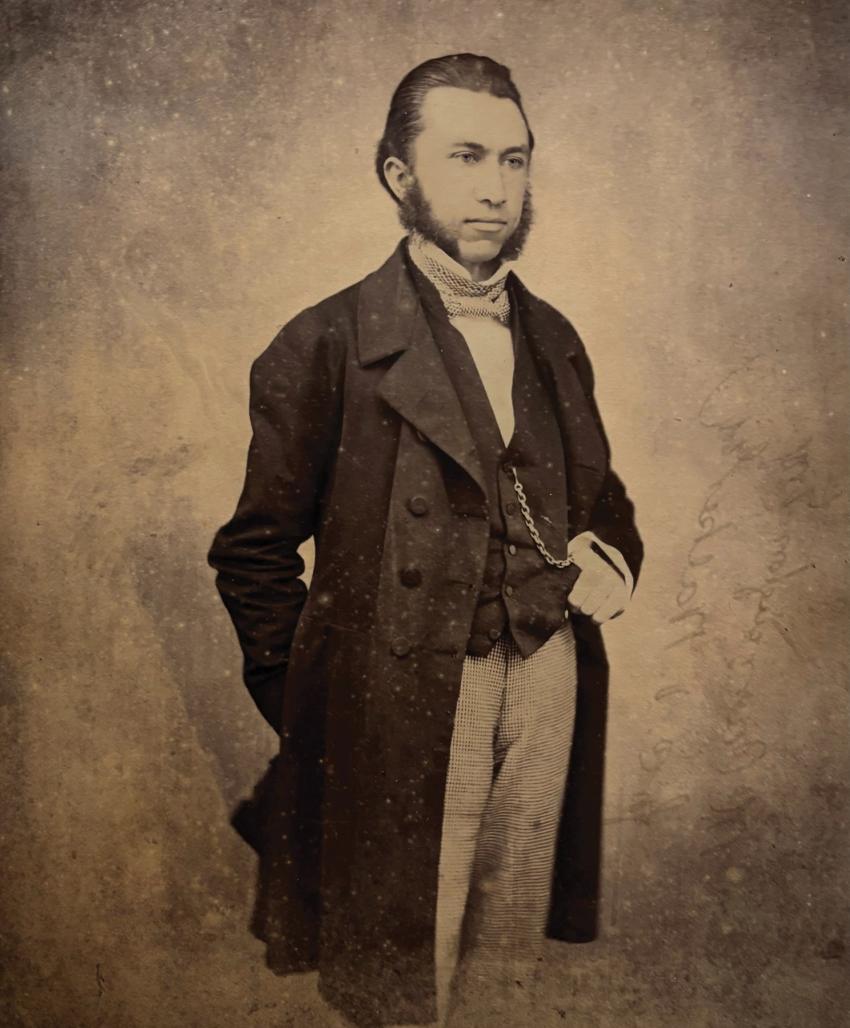

The first and so far only known photograph of 19th century astronomer Richard Carrington – who had the largest geomagnetic storm in history named after him – has been unearthed by the Royal Astronomical Society (RAS).
It was discovered 150 years after Carrington’s death following a speculative search by assistant archivist Kate Bond, who traced it all the way to America and confirmed its authenticity thanks to a series of remarkable clues.
Although the storm that bears his name is well known – having sparked fires at telegraph stations and intense auroral displays as far south as the Caribbean when it hit in 1859 – Carrington himself is not, despite being the most important solar astronomer of the 19th century.
That’s in part because no portrait of him was thought to exist – until now.
Like many of his contemporaries in science, Carrington had his photograph taken at the Maull & Polyblank studio in London as part of the Literary and Scientific Portrait Club.
It was assumed the image had not survived, but that all changed when Bond was discussing Carrington with a researcher in the Society’s library and decided to scour the internet for Maull & Polyblank photographs for sale.
“Up popped a photographic shop in the USA selling a group of these photographs,” she said, “and one of them had ‘the late Carrington’ written on it in pencil on the mount.
“The seller simply listed it as ‘Photo of Mr Carrington’, but with no biographical detail. I couldn’t believe it!”
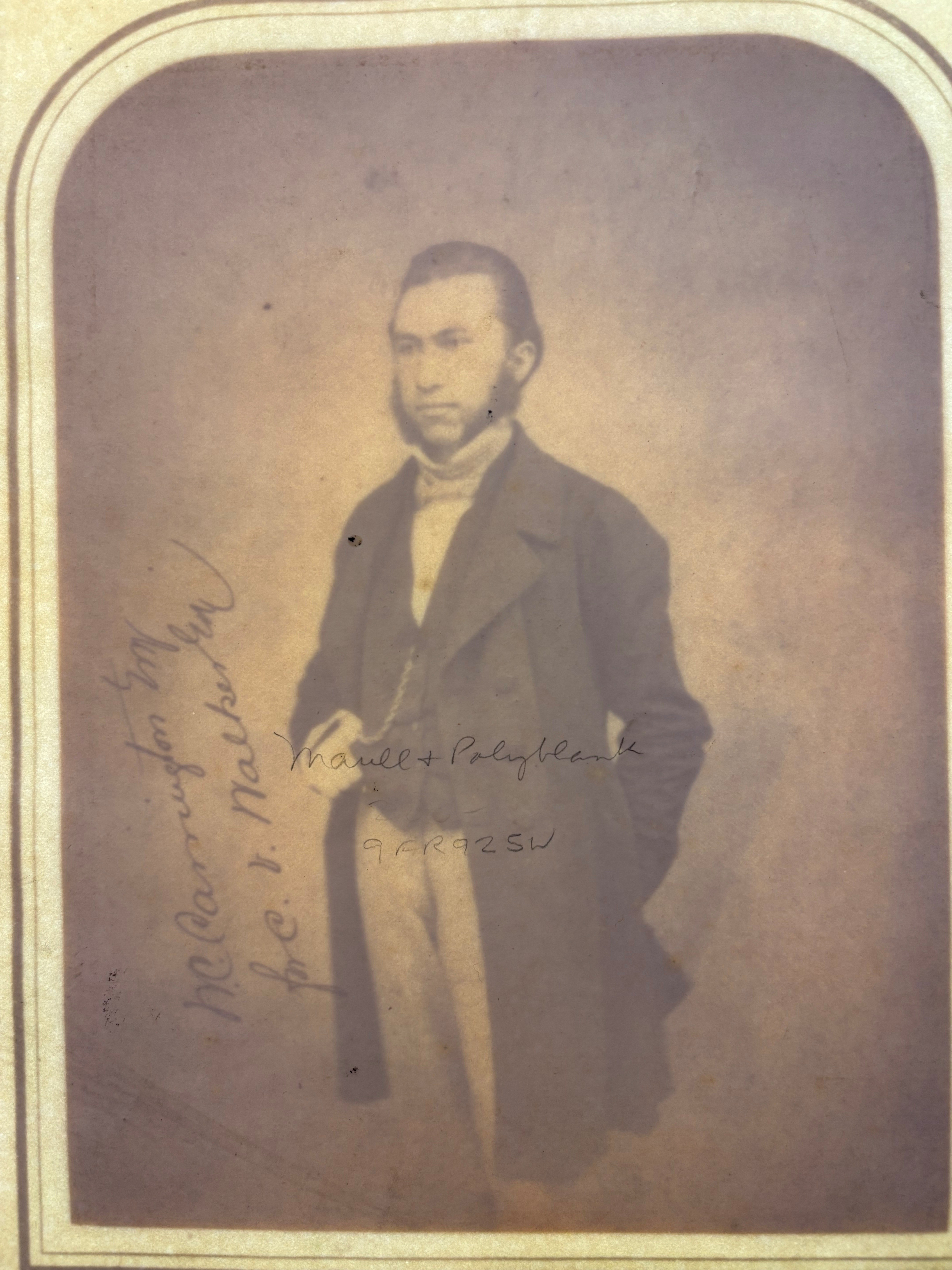
The picture had the right dimensions of the Club photos and showed a youngish man aged around 30, which fit with how old Carrington would have been in 1856.
“I bought it there and then,” Bond added. “I thought to myself, ‘If I’m wrong, I’ve just bought another picture of a Victorian man, but if I’m right…', well, I didn’t want to see that chance slip away.”
The Literary and Scientific Portrait Club operated between 1854 and 1865, when photography was a technology in its infancy and for many members, this was their first formal portrait photo.
The terms of admission to the club were that each member had to have their photograph taken by Maull & Polyblank at a cost of 10 shillings and 6 pence – around half the average weekly wage at the time.
There are two pieces of evidence that Carrington was a member of this club. Firstly, the National Portrait Gallery has a list of members and both his name and title of Secretary of the RAS – a post he held from 1857 to 1862 – are on it.
Ten members of the club who had already had their photos taken also sent a letter asking George Airy, the Astronomer Royal, to join them. Among those who signed it was an ‘R C Carrington’.
This, Bond said, showed that such a photo of Carrington must have existed.
RAS Fellows Ed Cliver, Lyndsay Fletcher and Hugh Hudson had conducted a previous search for the image via the National Portrait Gallery, the Royal Archives, the Museum of Photography, the Royal Society, the Science Museum and the University of Durham, along with the Getty Museum in Los Angeles, California and the Harry Ransom Center in Austin, Texas.
However, all their work drew a blank.
It later emerged that the owner of the photographic shop in Pittsburgh where Bond purchased the Maull & Polyblank image had himself acquired it after buying an album of the studio’s photographs from an auction in New York in the early 2000s.
He wanted a specific photo for his collection but did not need the rest so eventually put them up for sale.
But it wasn’t until Bond had the image in her possession that she realised it held another little secret `– the ‘smoking gun’ as it were.
“When I had the photograph in my hands, I could see some very faint writing on the image itself,” she said.
“I couldn’t read it: it was completely unintelligible. When we put it on a light box it became clearer, but it was back to front.”
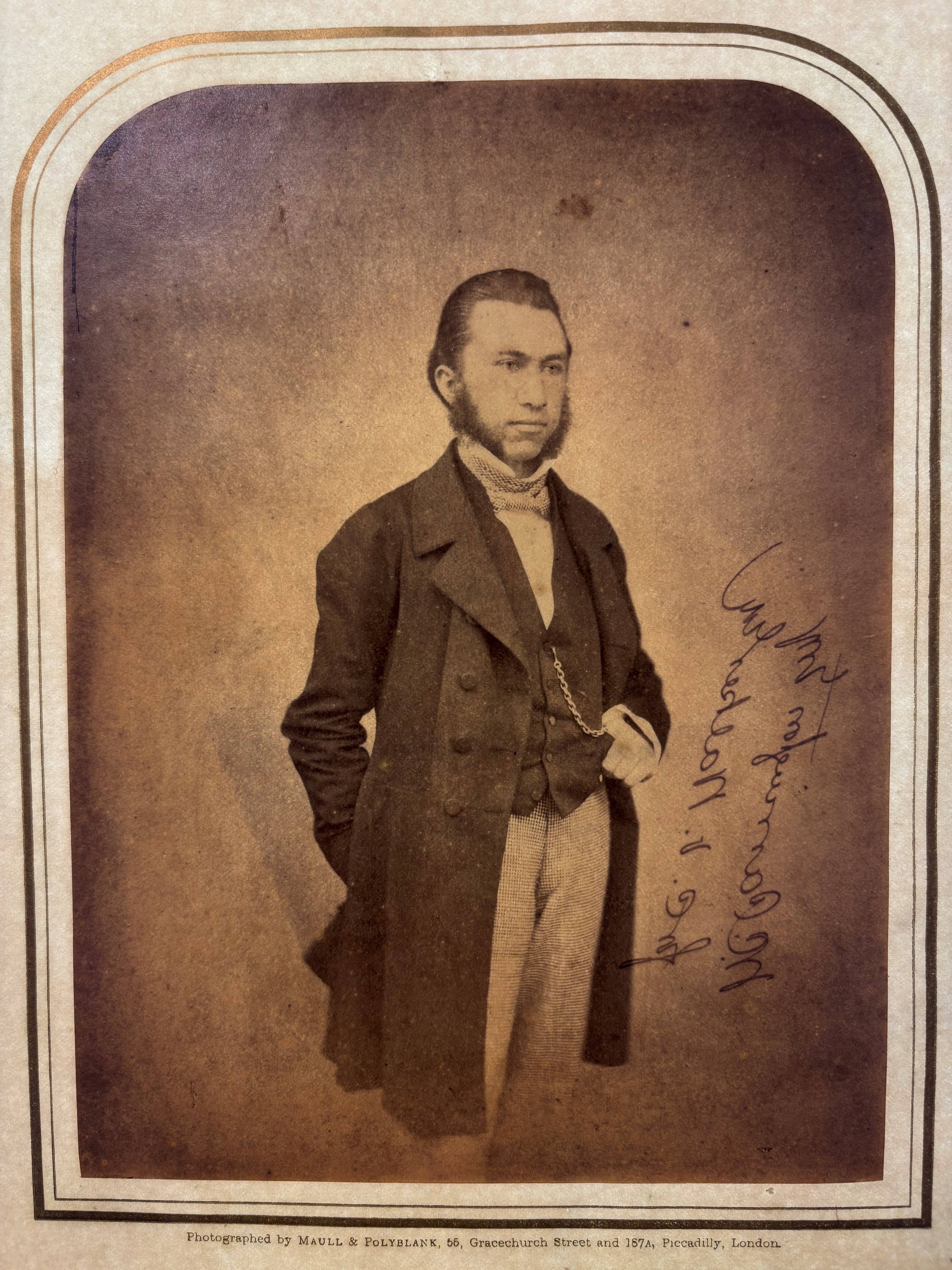
Bond took the image to the photographic department of John Rylands Library in Manchester to try to determine whether the inscription was on the back of the print, or perhaps smudged from a letter briefly placed on the image.
“Their opinion,” she added, “is that the lettering was almost certainly written on the back of the print before it was placed in the mount.
“In other words, it was written when the photograph was printed. This matters, because it says: ‘R C Carrington, Esquire for C V Walker, Esquire’. And that was amazing, because CV Walker is Charles Vincent Walker (1812–82), a Fellow of the Royal Society and also a Fellow of the RAS.
“He knew Carrington well, as he nominated him for his FRS (Fellowship of the Royal Society).”
This suggests that Walker, who was also a member of the Photographic Club, likely owned the image at some point and could have purchased it.
The photo will now be added to the RAS Archives, to go along with Carrington’s original observations of sunspots from 1853 to 1861.
“2025 marked the 150th anniversary of Carrington’s death and 2026 will be the bicentenary of his birth. I hope that the image will promote more interest in him and his work,” Bond said. That the photograph is linked to Charles Vincent Walker makes it even more special.
“I’m thrilled that we can finally have an image of this very important figure in the history of the RAS in our archive.
“Carrington had a close relationship with the RAS and left the Society £2,000 in his will (roughly £200,000 in today’s values).
“It is fitting that his photograph should also belong to the Society – it feels like he is coming home.”
ENDS
Media contacts
Sam Tonkin
Royal Astronomical Society
Mob: +44 (0)7802 877 700
press@ras.ac.uk
Kate Bond
Royal Astronomical Society
kbond@ras.ac.uk
Images & video
Richard Carrington
Caption: The first and so far only known photograph of 19th century astronomer Richard Carrington.
Credit: Royal Astronomical Society
Carrington image with handwriting
Caption: A light box helped reveal that ‘R C Carrington, Esquire for C V Walker, Esquire’ had been scribbled on the back of the mount.
Credit: Royal Astronomical Society
Carrington writing illegible
Caption: The front of the same image with a light box, with the writing illegible.
Credit: Royal Astronomical Society
Further information
An in-depth article about Kate Bond’s discovery of the first Carrington photo, published in February’s issue of the Royal Astronomical Society’s bimonthly house magazine Astronomy & Geophysics, can be read for free at: https://academic.oup.com/astrogeo/article/67/1/1.11/8444359
The emergence of the photograph is timely – last year was the 150th anniversary of Carrington’s death and the 26 May will mark the 200th anniversary of his birthday.
On 1 September 1859, Carrington recorded the first observed solar flare. When the extreme geomagnetic disturbance followed some 17 hours later, sparking fires at telegraph stations and intense auroral displays as far south as the tropics, he speculated about a possible link between the two. Despite this discovery laying the foundations for the discipline of space weather research, Carrington himself is not a familiar figure outside scientific literature.
For background, the Cliver et al. article setting out in detail why the photo was thought to exist is free to access at: https://doi.org/10.1093/astrogeo/atab059
Notes for editors
About the Royal Astronomical Society
The Royal Astronomical Society (RAS), founded in 1820, encourages and promotes the study of astronomy, solar-system science, geophysics and closely related branches of science.
The RAS organises scientific meetings, publishes international research and review journals, recognises outstanding achievements by the award of medals and prizes, maintains an extensive library, supports education through grants and outreach activities and represents UK astronomy nationally and internationally. Its more than 4,000 members (Fellows), a third based overseas, include scientific researchers in universities, observatories and laboratories as well as historians of astronomy and others.
The RAS accepts papers for its journals based on the principle of peer review, in which fellow experts on the editorial boards accept the paper as worth considering. The Society issues press releases based on a similar principle, but the organisations and scientists concerned have overall responsibility for their content.
Keep up with the RAS on Instagram, Bluesky, LinkedIn, Facebook and YouTube.
Download the RAS Supermassive podcast