


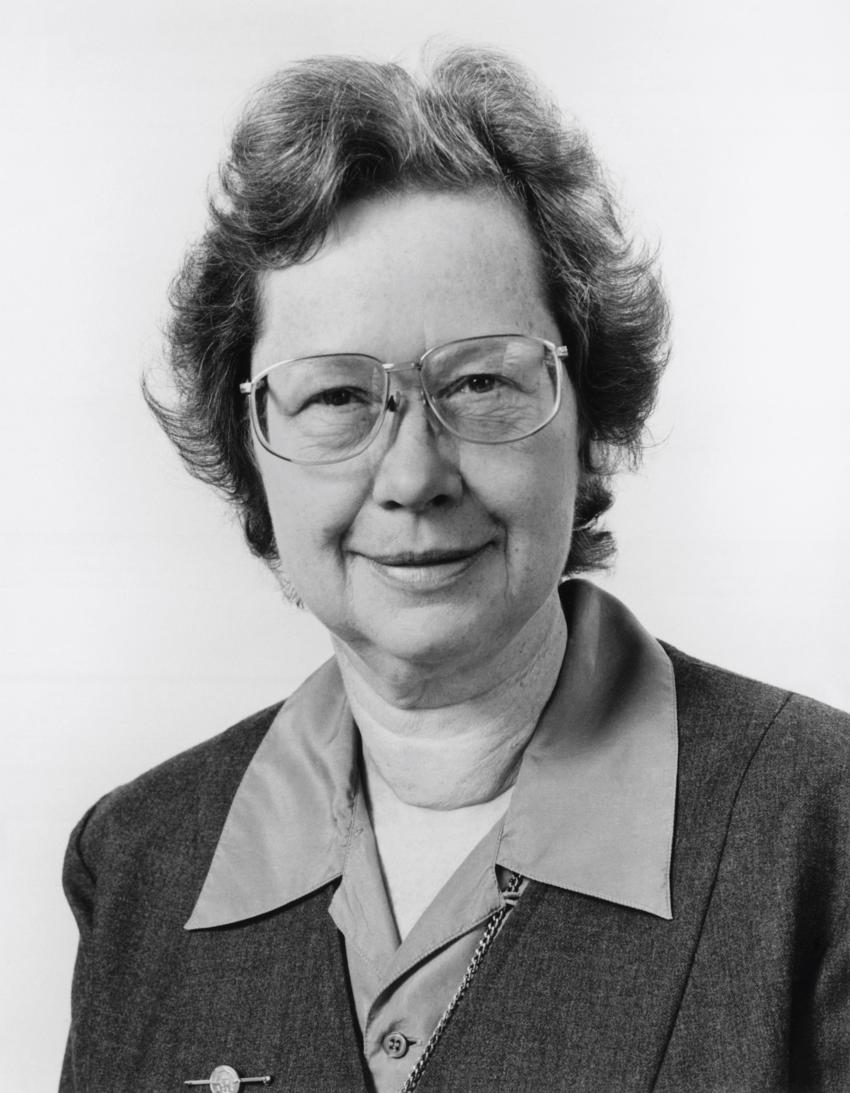

We are saddened to hear of the death of Professor Dame Carole Jordan – the first female president of the Royal Astronomical Society (RAS) – who has passed away at the age of 84.
Dame Carole also served on RAS Council for 22 years, was an editor of Monthly Notices of the Royal Astronomical Society from 1973 to 1986 and in 2005 became only the third woman to win the RAS Gold Medal, after Caroline Herschel in 1828 and Vera Rubin in 1996.
She was president of the RAS from 1994 to 1996.
Dame Carole was a solar physicist who was internationally renowned for her research into the coronae of the Sun and cool stars.
Current RAS President, Professor Mike Lockwood, called her a "trailblazer for women in science" and a "truly great supporter of the RAS".
"Dame Carole's friends will tell you the RAS was very close to her heart and whenever I met her in recent years she always asked questions about the Society," he said.
"She was a brilliant scientist, giving us the tools to turn ultraviolet observations into physical understanding of the solar corona, of cool stars, and of hot astrophysical plasmas – work for which she was awarded the RAS Gold Medal.
"She was very passionate about all that she did and was very supportive of young scientists. I served on RAS Council when she was president and she went out of her way to help and encourage me, then and throughout my career.
"The thing about Carole that I will never forget is her beaming and encouraging smile."
Dame Carole was made a Dame Commander of the Order of the British Empire in 2006 for services to physics and astronomy.
She became a Fellow of the Royal Society in 1990 and was also a council member for both the Science and Engineering Research Council and the Particle Physics and Astronomy Research Council.
She twice served on the Council of the Institute of Physics and was its first Vice-President, Science.
Dame Carole was educated at Harrow County Grammar School for Girls before going on to study at University College London. After obtaining her PhD, she spent time at the University of Colorado, Boulder and the UK Atomic Energy Authority, before gaining a professorship at the University of Oxford in 1996.
Her career centred on the use of x-ray and UV spectra as plasma diagnostics. She was a pioneer of the calculations required to determine the relative number densities of elements in different stages of ionization.
Dame Carole's observations of ultraviolet spectra with Skylab, a NASA space station that orbited the Earth from 1973 to 1979, helped to develop understanding of helium-like ions – also known as two-electron atoms.
As her career progressed, she became heavily involved with observations of stellar spectra, especially ones obtained from space platforms such as the International Ultraviolet Explorer (IUE) and the Hubble Space Telescope.
Dame Carole was one of the first female professors of Astronomy at the University of Oxford and head of its Rudolf Peierls Centre for Theoretical Physics from 2003 to 2008.
Her fellow Physics tutor at Somerville, Roman Walczak, remembered how strongly Dame Carole wished to encourage women's science research.
"If you ask me what was Carole's highest priority", he remembers, "I would say: promotion of women.
"After she retired, whenever we met, she was always asking me the same question: How many of our female students continue to a PhD? And her comment to my answer was always the same: 'try harder'."
Former RAS President Professor Martin Barstow said: "I first met Carole when I was a young post-doc, having recently joined the RAS at the beginning my career.
"Although she initially seemed a little formidable to me, this was the beginning of more than 40 years of friendship and collaboration.
"While I did not work directly in her field, she was enormously supportive of my research and always interested to hear what I was doing – generosity extended to many young scientists.
"She was still contributing to space mission proposals I was leading in the last few years. She made a huge contribution to the RAS in several roles, not least as its first female president. She will be greatly missed by us all."