Toolbar items

Back to site
Manage

Administration menu

  • Tools
FlexSlider Examples

FlexSlider examples menu

Anonymous

User account actions

  • Log in
Home
Logo RAS Mobile version

Contact us

Support usMy Account Created with Sketch.

Main navigation

  • Home
  • News & Press
    • Latest News
    • Research Highlights
    • Media Enquiries
  • Journals
    • Monthly Notices of the RAS (MNRAS)
    • Geophysical Journal International (GJI)
    • RAS Techniques & Instruments (RASTI)
    • Editorial Boards & Team
    • Editorial Policies
    • Advancing Astronomy & Geophysics
  • Events
    • RAS Meetings
    • External Meetings
    • Public Lectures & Events
    • Friends of the RAS Events
    • Past Events
  • Library
    • Visiting & Using the Library
    • Library Services
    • Archives
    • Other Collections
    • Help with your Research
    • Treasures from the Library & Archives
    • Obituaries
  • Awards & Grants
    • Fellowships
    • Awards, Medals and Prizes
    • Grants for Studies in Astronomy and Geophysics
  • Education & Outreach
    • Podcast
    • Education
    • Outreach
    • Careers
    • RAS200
    • Resources
    • Early Careers
  • About the RAS
    • Bicentenary
    • Burlington House
    • Bye-laws
    • Committees
    • Contacts
    • Council
    • Diversity
    • Sustainability
  • A&G
    • Latest A&G Articles
    • Contact A&G Editor
  • Membership
    • Fellows Membership
    • Friends of the RAS
  • Public Policy
    • Science Policy
    • Impact & Industry
    • Community & Demographics
    • Consultative Forums
  • Timeline
  • NAM 2026
Logo
  • Home
  • News & Press
    • Latest News
    • Research Highlights
    • Media Enquiries
  • Journals
    • Monthly Notices of the RAS (MNRAS)
    • Geophysical Journal International (GJI)
    • RAS Techniques & Instruments (RASTI)
    • Editorial Boards & Team
    • Editorial Policies
    • Advancing Astronomy & Geophysics
  • Events
    • RAS Meetings
    • External Meetings
    • Public Lectures & Events
    • Friends of the RAS Events
    • Past Events
  • Library
    • Visiting & Using the Library
    • Library Services
    • Archives
    • Other Collections
    • Help with your Research
    • Treasures from the Library & Archives
    • Obituaries
  • Awards & Grants
    • Fellowships
    • Awards, Medals and Prizes
    • Grants for Studies in Astronomy and Geophysics
  • Education & Outreach
    • Podcast
    • Education
    • Outreach
    • Careers
    • RAS200
    • Resources
    • Early Careers
  • About the RAS
    • Bicentenary
    • Burlington House
    • Bye-laws
    • Committees
    • Contacts
    • Council
    • Diversity
    • Sustainability
  • A&G
  • Membership
    • Fellows Membership
    • Friends of the RAS
  • Public Policy
    • Science Policy
    • Impact & Industry
    • Community & Demographics
    • Consultative Forums
  • Timeline
  • NAM 2026
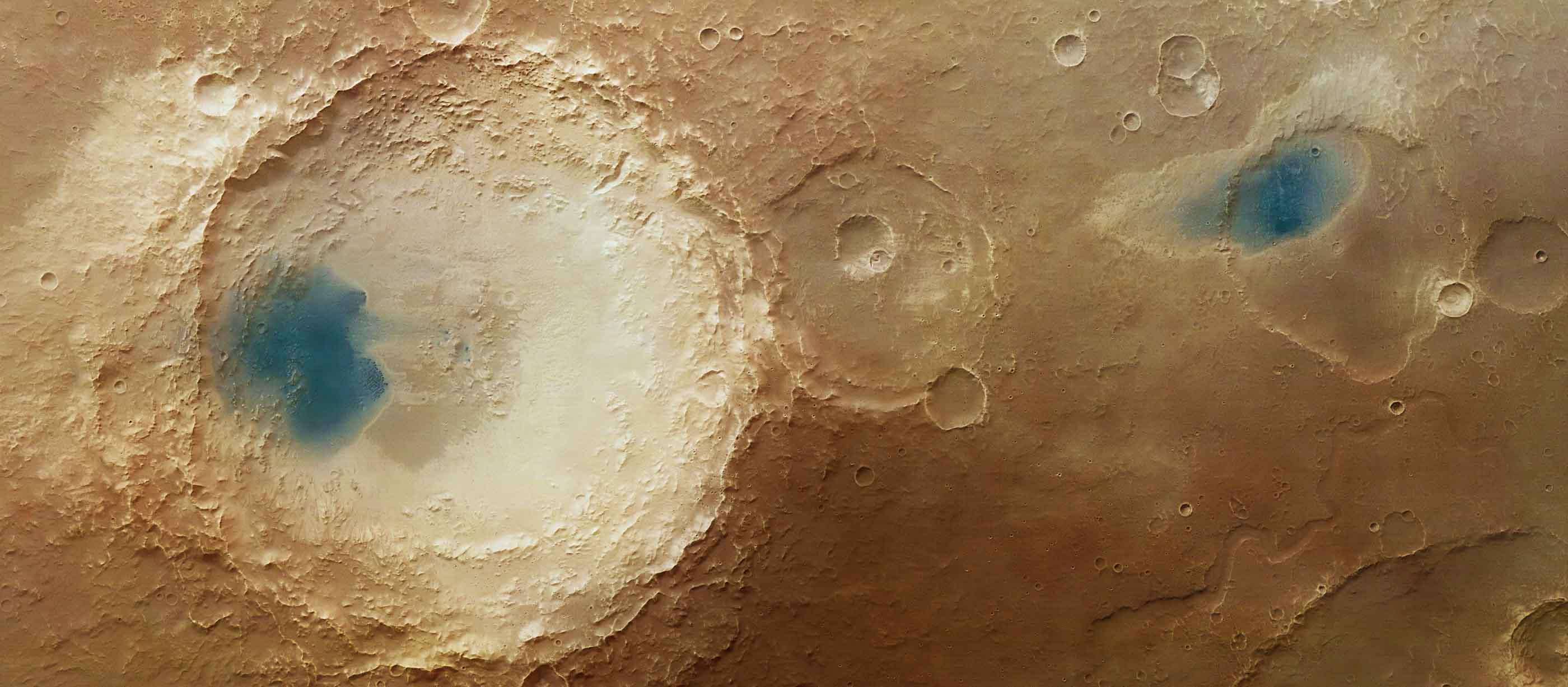
The European Space Agency
Crater Generations ArabiaTerra
(A) A dark matter map in our neighbourhood of the universe. The two large densities are dark matter halos of the Milky Way and Andromeda galaxy; (B) Zoomed-in on the dark matter map, showing a small dark matter clump ~700 million years after the Big Bang; (C-1 and C-2) stars and gas in the simulated ultra-faint dwarf galaxy, formed in the centre of the small dark matter halo in panel B. The two panels show two different radiation levels shortly after the Big Bang. It reveals how the ultra-faint dwarf galaxy
News

Milky Way's 'little cousins' may hold clues about infant univers…

Ultra-faint dwarf galaxies – tiny satellite galaxies orbiting the Milky Way – have long been seen as cosmic fossils. Now, a new study published today in Monthly Notices of the Royal Astronomical Society uses an unprecedented set...
RAS Fellows Professor Gillian Wright CBE (left), Dr Graeme McGhee (right) and Professor Rashid Sunyaev (inset) have been recognised in this year’s European Astronomical Society prizes.
News

European Astronomical Society awards prizes to trio of RAS Fellows

Visual impressions of the COLIBRE simulations
Research Highlights

See and hear galaxies evolve from the dawn of the universe

Read More
RAS logo on a purple starry background.
American Astronomical Society 'stands with' RAS amid cuts crisis
News
RAS logo placeholder
Research funding cuts threaten generation of scientists
News
An artist’s impression of the Milky Way, with two of its satellite galaxies – the Large Magellanic Cloud and the Small Magellanic Cloud – in the bottom left.
Galactic warming: The ‘car engine-like’ effect heating our Milky Way
Research Highlights
Professor Matthew Middleton alongside a cover of Monthly Notices of the Royal Astronomical Society.
Black hole expert to become next Editor-in-Chief of MNRAS
News
A diagram depicting habitable zone boundaries across star type with rocky exoplanets from Bohl et al. (2026). The boundaries of the habitable zone shift based on star colour, since different wavelengths of light will heat a planet's atmosphere differently. 
The best places to look for alien life: Scientists identify 45 Earth-like worlds to explore for a 'Project Hail Mary'
Research Highlights
Space background with floating coloured squares with text inside and the RAS logo
First HPQ Astronomy course piloted by RAS to end
News

Research Highlights

Visual impressions of the COLIBRE simulations
Research Highlights
See and hear galaxies evolve from the dawn of the universe
An artist’s impression of the Milky Way, with two of its satellite galaxies – the Large Magellanic Cloud and the Small Magellanic Cloud – in the bottom left.
Research Highlights
Galactic warming: The ‘car engine-like’ effect heating our Milky Way
A diagram depicting habitable zone boundaries across star type with rocky exoplanets from Bohl et al. (2026). The boundaries of the habitable zone shift based on star colour, since different wavelengths of light will heat a planet's atmosphere differently. 
Research Highlights
The best places to look for alien life: Scientists identify 45 Earth-like worlds to explore for a 'Project Hail Mary'
This image was taken by NASA's New Horizons spacecraft on 1 January 2019 during a flyby of Kuiper belt object 2014 MU69, known as Arrokoth.
Research Highlights
Why some objects in space look like snowmen
View all

Media Enquiries

‌  020 7292 3979

‌  press@ras.ac.uk

‌  About the RAS press office...

View all

Registered Charity No: 226545
Registered Company
No: RC000446

Useful links

  • Contact
  • Diversity
  • Anonymous Reporting
  • Feedback form
  • Privacy Policy
  • Report Links

RAS

  • About the RAS
  • Awards & Grants
  • Events
  • Journals
  • Library
  • News & Press
  • Public Policy

Membership

  • Become a Fellow
  • Current Fellows
  • Friends of the RAS

Follow us:

Copyright © 2024 Royal Astronomical Society. All Rights Reserved.