


Professor Jim Wild, a space physicist whose research focuses on the links between the Sun, Earth and other planets, has become the new president of the Royal Astronomical Society (RAS).
He succeeds Professor Mike Lockwood, of the University of Reading, whose two-year term in the role has now concluded.
Professor Wild's appointment began at the Society's Annual General Meeting today (Friday 8 May 2026), which also saw the election of a new secretary, two vice-presidents, and four councillors.
"As we navigate a challenging landscape for the UK research and higher education sectors, the Society's role in communicating the vital contribution of astronomy and geophysics is more critical than ever," said Professor Wild, of Lancaster University.
"My focus will be on ensuring our sciences are recognised not just for their cultural inspiration, but for their essential role in our scientific and economic future.
"Astronomy and geophysics can feel vast and complex, but at their heart, they are stories of human curiosity. I'm honoured to lead a Society that brings together people from all backgrounds to explore the mysteries of our world and the universe beyond."
Professor Wild's research explores the physics of the natural space environment, as well as those behind the Northern Lights, the impact of space weather on human technology and the interaction between planetary magnetospheres and the interplanetary environment.
He is a passionate science communicator – a commitment recognised in 2018 by the award of the James Dungey Lectureship by the RAS.
Professor Wild is also a member of an independent committee of space weather experts that provides support and advice to the UK Met Office and government departments, while in his spare time he is a keen fell runner.
The other council results are as follows, where 'A' covers all areas of astronomy and astrophysics, including exoplanets, and 'G' covers geophysics, solar, solar-terrestrial and planetary physics.
Dr Sheona Urquhart, of The Open University, has been elected as Secretary (A) for a five-year term. Professor Jorick Vink, of the Armagh Observatory and Planetarium, has been elected as a Vice President (A) and Dr Andy Nowacki, of the University of Leeds, as a Vice President (G). Both will serve a term of three years.
Four councillors, all serving for a term of three years, were also elected. They are:
Dr Olivia Keenan (A), Professor David Alexander (A/G), Dr Emma Woodfield (G) and Professor Peter Gallagher (A/G).
ENDS
Media contacts
Sam Tonkin
Royal Astronomical Society
Mob: +44 (0)7802 877 700
Images & captions
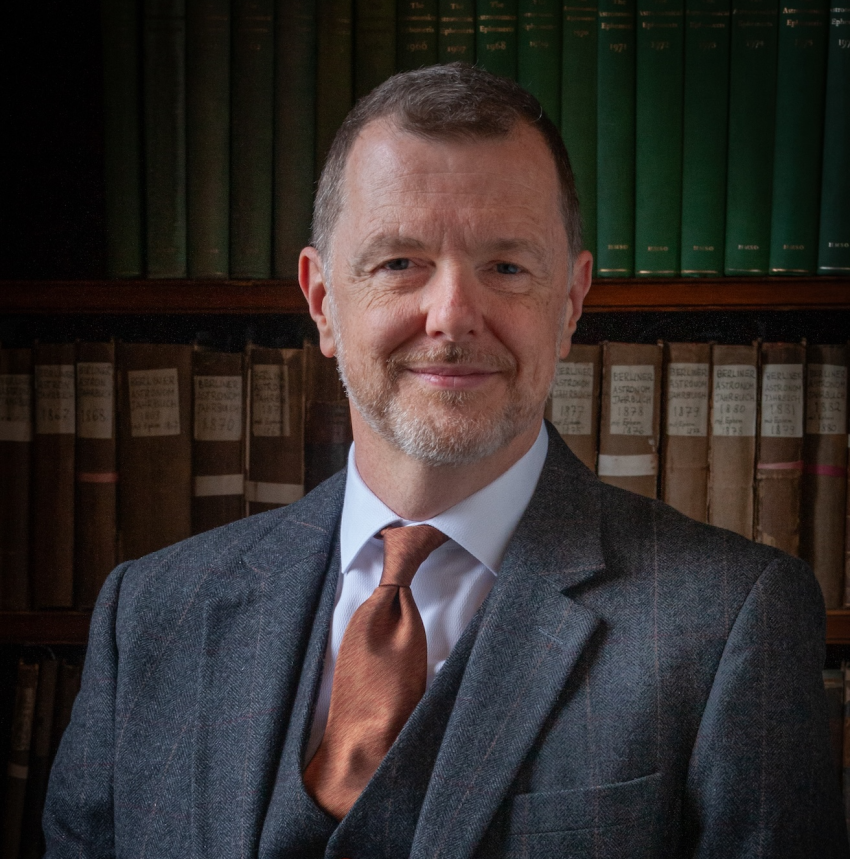
Caption: Professor Jim Wild, a space physicist at Lancaster University, has become the 106th President of the Royal Astronomical Society.
Credit: Lucinda Douglas-Menzies
Notes for editors
About the Royal Astronomical Society
The Royal Astronomical Society (RAS), founded in 1820, encourages and promotes the study of astronomy, solar-system science, geophysics and closely related branches of science.
The RAS organises scientific meetings, publishes international research journals, recognises outstanding achievements by the award of medals and prizes, maintains an extensive library, supports education through grants and outreach activities and represents UK astronomy nationally and internationally. Its more than 4,000 members (Fellows), a third based overseas, include scientific researchers in universities, observatories and laboratories as well as historians of astronomy and others.
The RAS accepts papers for its journals based on the principle of successful peer review, following which experts on the Editorial Boards accept the papers for publication. The Society issues press releases based on a similar principle, but the organisations and scientists concerned have overall responsibility for their content.
Keep up with the RAS on Instagram, Bluesky, LinkedIn, Facebook and YouTube.
Download the RAS Supermassive podcast