
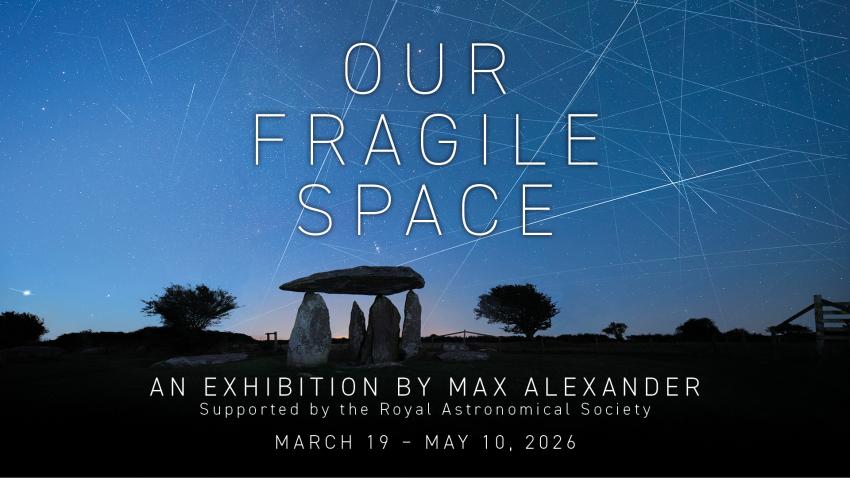

A ground-breaking photographic exhibition highlighting the grave and deepening issue of space debris is coming to Burlington House courtyard, the Royal Astronomical Society is delighted to announce.
Our Fragile Space shines a spotlight on the critical importance of space sustainability and the protection of the night sky through a powerful blend of reportage and artistic photography.
Since its premiere, the free exhibition has achieved significant international acclaim, serving as a powerful policy tool at many of the world's most influential venues to raise awareness of the biggest crisis astronomy has faced in its entire existence.
It will be open to the public outside the Society's offices in Piccadilly, central London, from 19 March to 10 May 2026.
Created and led by renowned science communicator and space photographer Max Alexander, the display will exhibit the growing threat space debris poses to our environment and way of life – concerns shared by the RAS, particularly in the wake of plans by SpaceX, Reflect Orbital and China to launch a combined 1.25 million satellites into an already crowded and increasingly perilous low-Earth orbit.
RAS President Professor Mike Lockwood said: "Max Alexander's brilliant exhibition is a powerful and timely reminder of the growing threat of space junk.
"Thought-provoking and instructive in equal measure, the images add weight to an urgent question in need of a global answer – how do we tackle a problem that could have devastating consequences not just for astronomy, but for us all?"
The project provides a compelling visual narrative for the "fourth domain" of environmental concern: the near-space environment, while also championing the people and initiatives leading the way in combatting the issue.
By bringing the invisible reality of orbital hazards to the public eye, Our Fragile Space has transitioned from a traditional gallery display into a vital catalyst for global diplomatic and scientific discussion.
It has been showcased at the United Nations in both New York and Vienna, the European Parliament in Brussels, and Lloyd's of London. This global reach has allowed the exhibition to bridge the gap between complex orbital mechanics and public consciousness, advocating for the stewardship of our skies on an international stage.
Its most significant legacy is its role in shaping international space policy and its contribution to the UK Space Agency's In-Orbit Servicing, Assembly, and Manufacturing (ISAM) framework.
In recognition of the project's impact, the Our Fragile Space team – including Steve Kelly and Dr Stuart Clark – received the prestigious Sir Arthur Clarke Team Media Award.
Hosted and supported by the RAS, the exhibition continues to champion the protection of dark and quiet skies, advocating for the preservation of the night sky as a shared human heritage against unprecedented satellite expansion.
No booking is required to see the display, which is free to view for all.
ENDS
Media contacts
Sam Tonkin
Royal Astronomical Society
Mob: +44 (0)7802 877 700
Max Alexander
Our Fragile Space
Mob: +44 (0)7860 403373
Images & captions
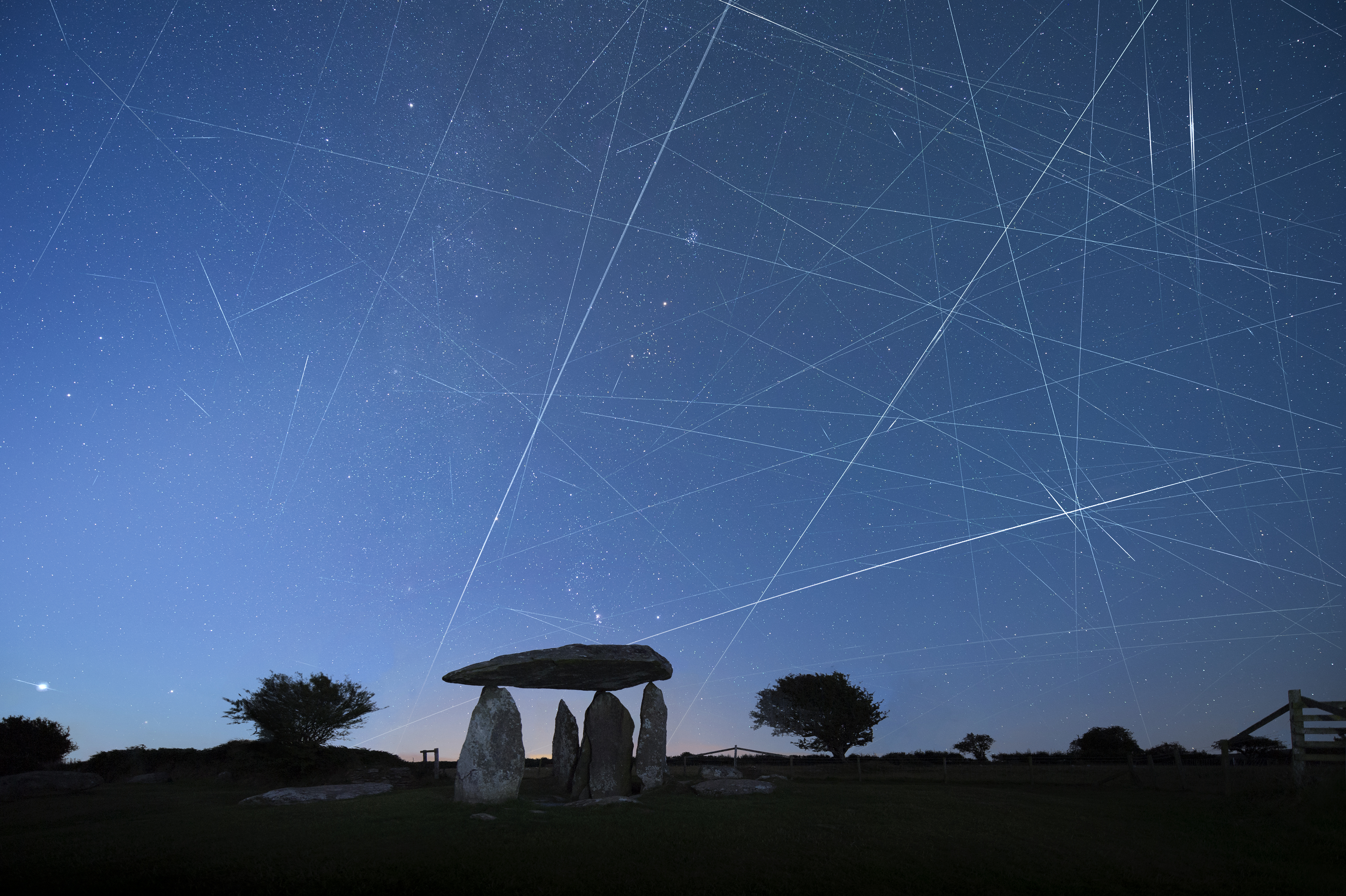
Satellite trails over Pentre Ifan
Caption: Not only can the Milky Way and constellations of Orion and Taurus be seen in this image, so too can trails left by numerous satellites crossing the sky, including those from the Starlink mega-constellation. The International Space Station and myriad other satellite and rocket bodies are also visible.
Credit: Max Alexander
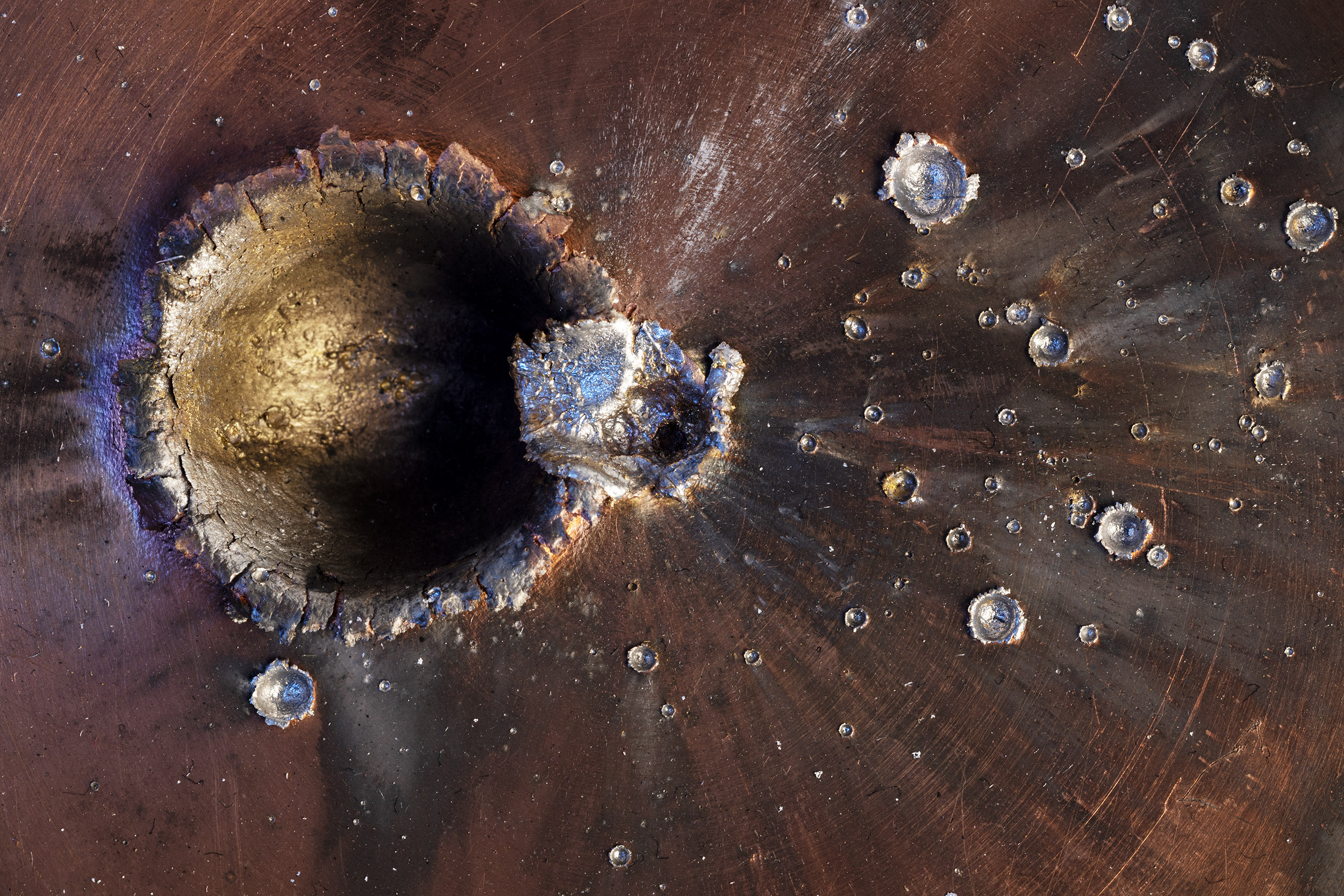
Caption: This image may look like an alien landscape, but it is actually a copper test target from the Hypervelocity Impact Facility at the University of Kent. The laboratory fires projectiles from 3 to 3.5 millimetres across at speeds of 1 to 7.5 kilometres per second. Such hypervelocities are representative of the speeds at which objects hit each other in orbit.
Credit: Max Alexander
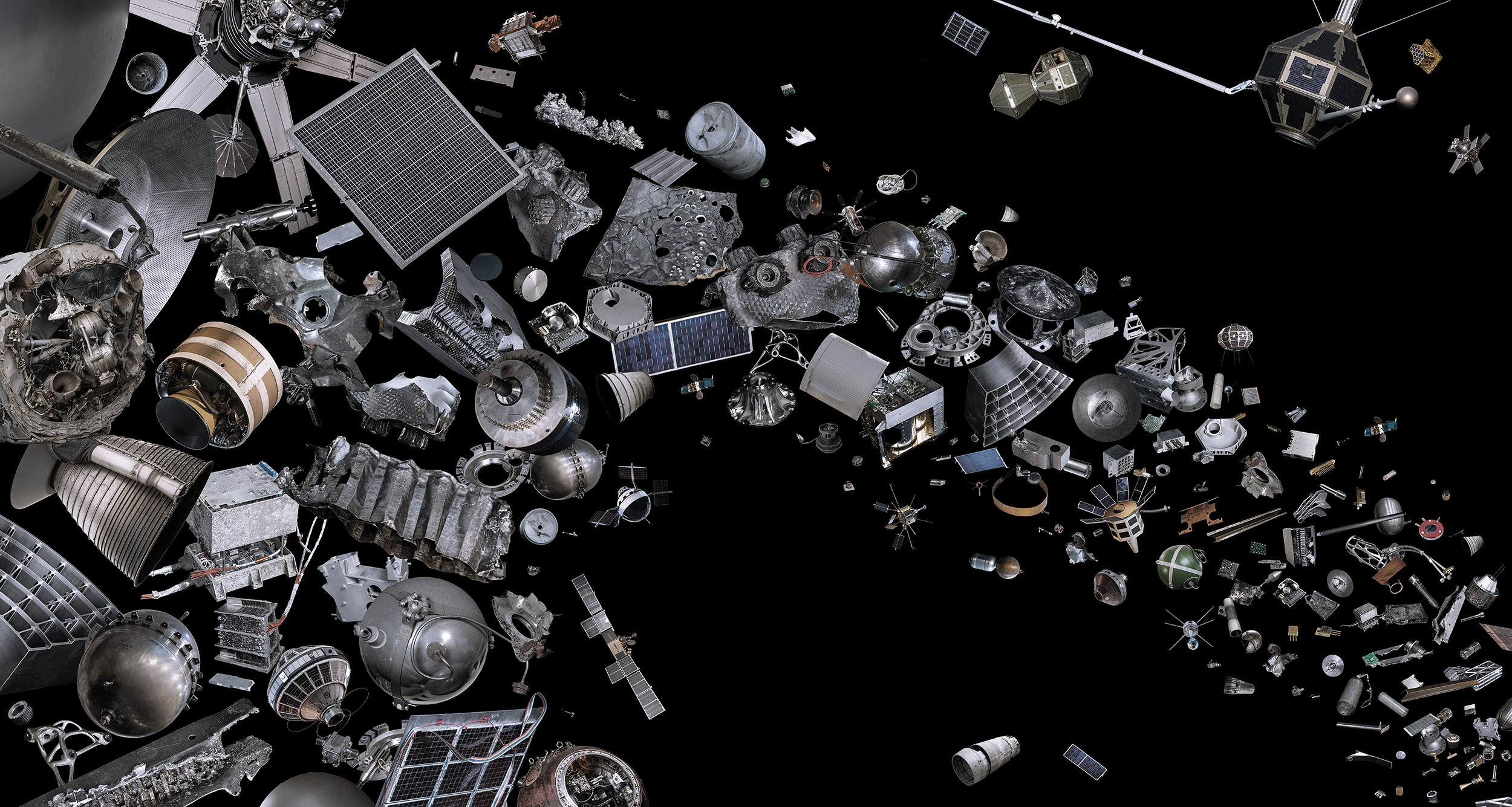
Caption: Artwork by Steve Kelly, created from 250 individual photographs of examples of what is in orbit, taken by Max Alexander.
Credit: Max Alexander/Steve Kelly
Notes for editors
About Max Alexander
Max Alexander is an international photographer and creative strategist specialising in visual storytelling for prestigious organisations including the SKA Observatory, European Space Agency, and the UK Space Agency. From Nobel laureates to astronauts, Alexander has captured the individuals shaping our understanding of the cosmos.
His exhibition Our Fragile Space has received international acclaim for its compelling narrative on the sustainability of the orbital environment. Showcased at the United Nations, the European Parliament and Lloyd’s of London, the project has influenced international space policy and was instrumental setting up UK Space Agency's circular space economy frameworks.
A Fellow of the Royal Astronomical Society, Alexander's passion for making the universe meaningful has led to several high-profile, science-led exhibitions. Projects such as Explorers of the Universe and Illuminating Atoms premiered at the Royal Albert Hall before embarking on national tours, while Life in the Sun’s Atmosphere highlighted the intersection of solar science and global risk at the iconic Lloyd's Building.
His work on space sustainability and protecting the night sky was also recognised when asteroid 6548 Maxalexander was named after him. He proposed United Nations-sanctioned International Asteroid Day and is their Photographer-in-Residence. Whether training an astronaut for their photography on the International Space Station or delivering influential exhibitions, Alexander's work acts as an essential bridge between complex science and the public consciousness.
‘Our Fragile Space’ project partners:
Lloyd's of London
UK Space Agency
SKAO
Astra Carta, SMI
Warwick University
Project sponsors
Royal Astronomical Society
Airbus
Viasat
Royal
DSTL
D-Orbit
3S Northumbria
CPS
Astroscale
EUMETSAT
Secure World Foundation
About the Royal Astronomical Society
The Royal Astronomical Society (RAS), founded in 1820, encourages and promotes the study of astronomy, solar-system science, geophysics and closely related branches of science.
The RAS organises scientific meetings, publishes international research and review journals, recognises outstanding achievements by the award of medals and prizes, maintains an extensive library, supports education through grants and outreach activities and represents UK astronomy nationally and internationally. Its more than 4,000 members (Fellows), a third based overseas, include scientific researchers in universities, observatories and laboratories as well as historians of astronomy and others.
The RAS accepts papers for its journals based on the principle of peer review, in which fellow experts on the editorial boards accept the paper as worth considering. The Society issues press releases based on a similar principle, but the organisations and scientists concerned have overall responsibility for their content.
Keep up with the RAS on Instagram, Bluesky, LinkedIn, Facebook and YouTube.
Download the RAS Supermassive podcast