

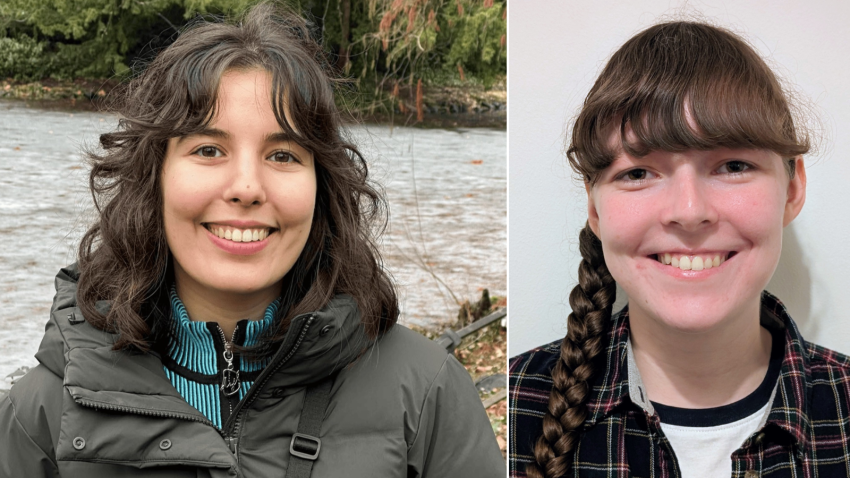

A planetary scientist focusing on Saturn's largest moon and a radio astronomer at the UK’s iconic Jodrell Bank have been named as joint winners of the inaugural RAS Techniques and Instruments (RASTI) Student Prize.
Maria Santos Coelho, who is completing her MSc in Engineering Physics at Instituto Superior Técnico, University of Lisbon, and Alex Walls, a second-year PhD student at the University of Manchester, were recognised for submitting the 'best' papers published by a student scientist.
RASTI is a peer-reviewed scientific journal which provides an international forum for high-quality papers covering data science, software, and instrumentation, in astrophysics and geophysics. The journal, which is celebrating its 5th anniversary this month, is overseen by an Editorial Board which supports the Royal Astronomical Society's charitable activities.
"I'am deeply honoured to receive the 2026 RASTI Student Prize," said Coelho. "This recognition is especially meaningful to me as it acknowledges my first scientific publication and the work I developed during my master's thesis."
"It came as a wonderful surprise at a time when I am still discovering my path as a researcher, and it encourages me to continue pursuing my dream of becoming a planetary scientist."
She added: "I'm very grateful to my supervisors and co-authors, Rafael Rianço-Silva, Diogo Gonçalves, Pedro Machado and Zita Martins, whose guidance, encouragement, and support made this work possible."
Walls said: "I'm really happy to receive this prize, especially as this was my first paper. I’m very grateful to my supervisor, Anna Scaife, and to James Barry and Devina Mohan for their support and contributions that made this work possible."
Coelho was recognised for her paper 'Detection of hydrocarbons in Titan using high resolution cross-correlation spectroscopy'.
Her research focuses on the study of planetary atmospheres using high-resolution spectroscopy, with particular emphasis on Titan, Saturn's largest moon.
Using observations from CRIRES+ on the European Southern Observatory's Very Large Telescope (VLT), she developed a new method for building cross-correlation templates from laboratory cross-sections, which led to the first high-resolution cross-correlation spectroscopy detection of ethane (C₂H₆).
The technique opens the door to detecting complex molecules that usually lack complete line lists, including possible biosignatures, in both our Solar System and exoplanet atmospheres.
She hopes to pursue a PhD in planetary science and astrobiology.
Walls, a second-year PhD student whose work at the Jodrell Bank Centre for Astrophysics applies deep learning to radio astronomy, was recognised for the paper 'Monte Carlo conformal prediction for quantifying uncertainty in radio galaxy classification under ambiguous ground truth'.
Her PhD project is focused on using self-supervised learning to train models on multiple observations of the same objects from different radio telescopes or surveys, with the aim of learning representations that reflect the objects' physical properties instead of the characteristics of the observations.
The RASTI Student Prize is designed to celebrate and acknowledge the contribution of student authors to the journal, and to be eligible, they had to be the corresponding or first author.
The winners will each receive £500 in prize money, a certificate of recognition, and a fee waiver for any subsequent paper submitted to the journal. Their papers will also be featured in Astronomy & Geophysics, the RAS's bimonthly house magazine.
To find out more about the RASTI Student Prize, including details on how to enter the 2027 award, click here.