


The Milky Way may have undergone a dramatic change in orientation during its history, according to new research that helps explain a long-standing mystery about our galaxy.
Using supercomputer simulations of galaxies like the Milky Way, a team of astronomers from Durham University found that galaxies with slowly rotating stellar haloes are more likely to have experienced a major 'disc flip', where the galaxy's disc changed its orientation by more than 90 degrees.
The research has been presented today at the Royal Astronomical Society's National Astronomy Meeting in Birmingham.
Most of the Milky Way's stars are found in its flat spiral disc. Surrounding this is a much larger but much sparser stellar halo, made up mostly of stars that originally formed in smaller galaxies before being pulled into the Milky Way through galaxy mergers.
Observations from the European Space Agency's Gaia mission have shown that the Milky Way's stellar halo rotates very slowly, but astronomers have not understood why.
To investigate, the researchers analysed the evolution of 25 Milky Way-like galaxies in the Auriga suite of cosmological simulations, following their development over billions of years.
They found that galaxies with the slowest rotating stellar haloes shared two important features. They had experienced a major head-on merger with another galaxy, and they had also undergone a disc flip during their evolution.
"We already know that the Milky Way had a massive head-on collision in the past with a galaxy known as Gaia-Sausage-Enceladus (often simply called the Gaia Sausage). So, we think that the Milky Way disc likely flipped in the past," explained astronomer Kirill Batrakov, the lead researcher on the project.
The Gaia-Sausage-Enceladus was a massive dwarf galaxy that collided with and was absorbed by the early Milky Way about 10 to 11 billion years ago. This defining galactic merger was the largest event in the early history of the Milky Way and reshaped our galaxy, leaving billions of stars orbiting in highly elongated, sausage-shaped paths.
Identifying a past disc flip gives astronomers a new way to understand how the Milky Way assembled and may also provide indirect clues about the motion of its invisible dark matter halo.
"A disc flip also means most of the Milky Way's stars once moved on very different trajectories than they do today – possibly even our own Sun, meaning our 'stable' spot in the galaxy might not have been so stable for the Solar System's whole lifetime," Batrakov said.
The Milky Way is our best laboratory for testing how galaxies and dark matter evolve. A disc flip does not happen in every galaxy, so if its history included a major flip that has not been linked to observable features of our galaxy, then it offers astronomers clues about how similar galaxies formed.
"Because we live inside the Milky Way, we can study it in more detail than any other galaxy, which makes it a key testbed for understanding galaxies more broadly," Batrakov added.
"Finding that its disc flipped adds a new chapter to that story, one we must account for when placing the Milky Way in a broader context of other galaxies. What excites me the most is that this complex history can be reconstructed just from present-day observations."
Batrakov's study also found that the rotation of the Milky Way's stellar halo is closely linked to the rotation of its dark matter halo, suggesting the two possibly evolved together as the galaxy grew by accreting smaller satellite galaxies.
The findings provide a possible explanation for one of the Milky Way's unusual features and offer new clues about how our galaxy formed and evolved over billions of years.
ENDS
Media contacts
Sam Tonkin
Royal Astronomical Society
Mob: +44 (0)7802 877 700
Dr Robert Massey
Royal Astronomical Society
Mob: +44 (0)7802 877 699
Megan Eaves
Royal Astronomical Society
Science contacts
Kirill Batrakov
Durham University
Images & video
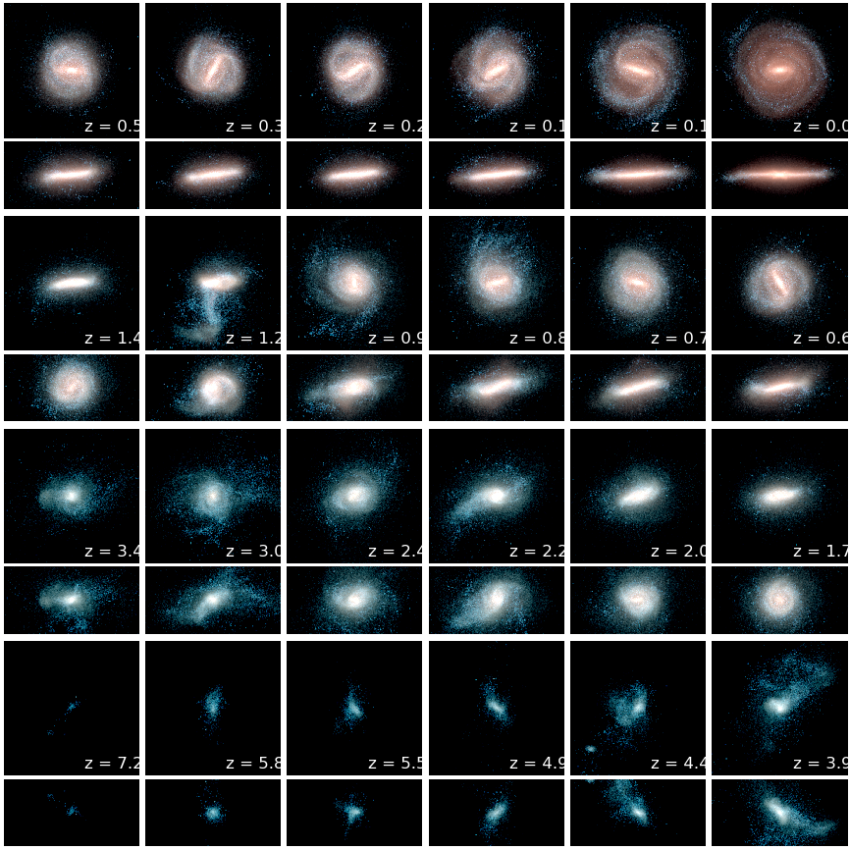
Image 1: Halo 18 is an example of a galaxy that had a head-on collision (see the panel at z=1.2) and had a disc flip (you can see this by comparing the disc orientation at z=1.4 and z=0). This image and Image 2 show how these two exemplary galaxies evolve with time: each panel corresponds to a different time defined by redshift (z). Redshift is a quantity used by astronomers to measure the time in the universe, with z=0 corresponding to the present day, and larger z corresponding to earlier times. Each z has two panels associated with it, which show how the galaxy looks in two planes (like the xy and xz planes in 3D space).
https://drive.google.com/file/d/1X20dQVA3jQEWZA8nAM3JvQWE3mZIIP3i/view?usp=drive_link
Credit: Auriga Project
Image 2: Halo 6 is an opposite example: it did not have a head-on collision (for example, the collision at z=2.2 is more aligned with the orientation of its disc), and its disc did not flip. https://drive.google.com/file/d/1yV6uMyIL5izNvYWy8lI5ICEFpeROECdN/view?usp=drive_link
Credit: Auriga Project
Image 3: Artist's impression of the merger between the Gaia-Enceladus galaxy and our Milky Way, which took place during our galaxy’s early formation stages, 10 billion years ago. Astronomers uncovered this major event in the formation history of the Milky Way after discovering an ‘odd collection’ of stars that move along elongated trajectories in the opposite direction to the majority of the galaxy’s other hundred billion stars, including the Sun. The discovery was possible thanks to the second data release of ESA’s Gaia mission and its extraordinary precision. The positions and motions of the stars in Gaia-Enceladus (represented with yellow arrows) in this early phase of the merger are based on a computer simulation that models a similar encounter to that uncovered by Gaia.
https://drive.google.com/file/d/1WrSkH2PxrrwUJ7MrEzf9OJbronvW9D66/view?usp=drive_link
Credit: ESA (artist’s impression and composition); Koppelman, Villalobos and Helmi (simulation); NASA/ESA/Hubble (galaxy image) / CC BY-SA 3.0 IGO
Image 4: Artist's impression of debris of the Gaia-Enceladus galaxy. Yellow arrows represent the positions and motions of stars originating from Gaia-Enceladus in a simulation of a galactic merger with the Milky Way with characteristics similar to those implied by Gaia data.
https://drive.google.com/file/d/1Og9pSLpXCMoEXaY1CMhVk5StJgvVwOJo/view?usp=drive_link
Credit: ESA (artist's impression and composition); Koppelman, Villalobos and Helmi (simulation) / CC BY-SA 3.0 IGO

Figure 1: Diagram showing the distribution of stars within the galaxy and its infalling satellite. This image shows a face-on projection; the second image (xz) shows an edge-on projection.
https://drive.google.com/file/d/1LAPkFiOkLrcxEpNl16wvws-AHbVC7dvR/view?usp=drive_link
Credit: Kirill Batrakov
Figure 2: Diagram showing the distribution of stars within the galaxy and its infalling satellite. These images illustrate an edge-on projection of the ‘head-on’ collision that the galaxy underwent.
https://drive.google.com/file/d/1peDRnjjQDled7lj1GlTcfsROigIdXNJy/view?usp=drive_link
Credit: Kirill Batrakov
Video 1: A video which shows the evolution of halo 18. It shows the same thing as images 1-2, but in video format.
https://drive.google.com/file/d/1upt2EJp0_onbujC5AC-_rtQeFpXz3Bxt/view?usp=drive_link
Credit: Auriga Project and Thomas Tomlinson
Further information
The talk ‘Why is the Milky Way stellar halo slowly rotating?’ took place at NAM2026 at 15:30 BST on Tuesday 21 July 2026 in room TLC118/119. Find out more at: https://uobevents-national-astronomy-meeting-2026.eventsairsite.com/block-schedule.
Notes for editors
About the Royal Astronomical Society
The Royal Astronomical Society (RAS), founded in 1820, encourages and promotes the study of astronomy, solar-system science, geophysics and closely related branches of science.
The RAS organises scientific meetings, publishes international research journals, recognises outstanding achievements by the award of medals and prizes, maintains an extensive library, supports education through grants and outreach activities and represents UK astronomy nationally and internationally. Its more than 4,000 members (Fellows), a third based overseas, include scientific researchers in universities, observatories and laboratories as well as historians of astronomy and others.
The RAS accepts papers for its journals based on the principle of successful peer review, following which experts on the Editorial Boards accept the papers for publication. The Society issues press releases based on a similar principle, but the organisations and scientists concerned have overall responsibility for their content.
Keep up with the RAS on Instagram, Bluesky, LinkedIn, Facebook and YouTube.
Download the RAS Supermassive podcast
About the Science and Technology Facilities Council
The Science and Technology Facilities Council (STFC), part of UK Research and Innovation (UKRI), is the UK’s largest public funder of research into astronomy and astrophysics, particle and nuclear physics, and space science. We operate five national laboratories across the UK which, supported by a network of additional research facilities, increase our understanding of the world around us and develop innovative technologies in response to pressing scientific and societal issues. We also facilitate UK involvement in a number of international research activities including the ELT, CERN, the James Webb Space Telescope and the Square Kilometre Array Observatory.
About The University of Birmingham
The University of Birmingham is ranked amongst the world's top 100 institutions. Its work brings people from across the world to Birmingham, including researchers, educators and more than 40,000 students from over 150 countries.
England’s first civic university, the University of Birmingham, is proud to be rooted in one of the most dynamic and diverse cities in the country. A member of the Russell Group and a founding member of the Universitas 21 global network of research universities, the University of Birmingham has been changing the way the world works for more than a century.
The University of Birmingham is committed to achieving operational net zero carbon. It is seeking to change society and the environment positively, and use its research and education to make a major global contribution to the UN Sustainable Development Goals. Find out more about our approach to sustainability.