
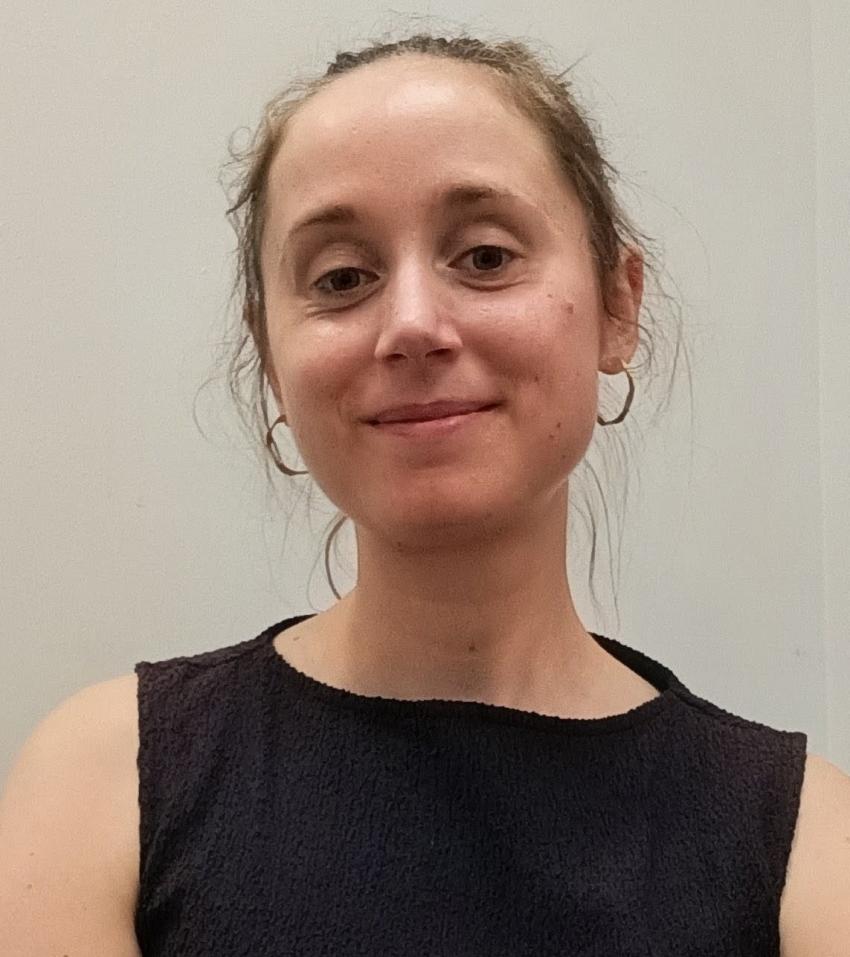

One of the UK's brightest emerging astrophysicists – who specialises in the research of gravitational waves – has been named as the winner of the 2026 Caroline Herschel Prize Lectureship.
Dr Isobel Romero-Shaw, an STFC Ernest Rutherford Fellow based at Cardiff University, was recognised for pioneering the use of gravitational wave signals from distant compact binary systems (black holes or neutron stars orbiting each other) to determine the nature of their orbits.
Her lecture topic will be 'Violent Beginnings Have Violent Ends: Deciphering the Origins of Binary Compact Object Collisions with Gravitational Waves'.
"I am thrilled and honoured to have been awarded the 2026 Caroline Herschel Prize Lectureship," she said. "We are only a decade into the era of observational gravitational-wave astronomy, yet we have already witnessed hundreds of violent collisions between stellar remnants: black holes and neutron stars.
"These discoveries are transforming how we understand the lives of stars, how they evolve together, and how they continue and conclude their cosmic dance after death.
"It is fantastic to see the Herschel Society and the Royal Astronomical Society sharing in the excitement of this rapidly growing field, and I am looking forward to bringing that excitement to new audiences through these lectures."
The award panel said Dr Romero-Shaw had demonstrated excellence in research, including leadership within the LIGO-Virgo-KAGRA collaboration of gravitational wave observatories, and a strong publication record. This led to her being awarded a prestigious STFC Ernest Rutherford Fellowship at an unusually early career stage.
They also cited her excellent track record in outreach and communication, having illustrated and co-created children's science books and worked with Bristol’s science centre, We The Curious.
The Caroline Herschel Prize Lectureship was established in 2018 by what is now the Herschel Society, in association with the Royal Astronomical Society (RAS), to celebrate Caroline’s memory by supporting promising women astronomers early in their careers.
Caroline, William's younger sister, started out as his assistant, but in time became recognised as an important astronomer in her own right, was the first to be paid as such, and was awarded the RAS Gold Medal in 1828.
Previous winners of the Caroline Herschel Prize Lectureship include Dr Victoria Fawcett, Dr Heloise Stevance, Dr Marie Van de Sande and Dr Alexandra Amon.
The Caroline Herschel Prize Lecture is hosted by the University of Bath in November, in cooperation with the Society as part of the university's public lecture series. It is also hosted by the RAS the following April.
Charles Draper, chairman of the Herschel Society, said: "Caroline Herschel was meticulous and indefatigable in her recording of distant astronomical objects.
"She would have been amazed to see how researchers such as Dr Romero-Shaw were using entirely novel technologies to discover and investigate new types of astronomical objects unknown in her day."
ENDS
Media contacts
Sam Tonkin
Royal Astronomical Society
Mob: +44 (0)7802 877 700
Notes for editors
About the Royal Astronomical Society
The Royal Astronomical Society (RAS), founded in 1820, encourages and promotes the study of astronomy, solar-system science, geophysics and closely related branches of science.
The RAS organises scientific meetings, publishes international research journals, recognises outstanding achievements by the award of medals and prizes, maintains an extensive library, supports education through grants and outreach activities and represents UK astronomy nationally and internationally. Its more than 4,000 members (Fellows), a third based overseas, include scientific researchers in universities, observatories and laboratories as well as historians of astronomy and others.
The RAS accepts papers for its journals based on the principle of successful peer review, following which experts on the Editorial Boards accept the papers for publication. The Society issues press releases based on a similar principle, but the organisations and scientists concerned have overall responsibility for their content.
Keep up with the RAS on Instagram, Bluesky, LinkedIn, Facebook and YouTube.
Download the RAS Supermassive podcast